Inside the 9/11 Museum
The pavilion
The entry pavilion at 180 Greenwich Street was designed by Snøhetta. Two steel tridents, 80 feet tall, salvaged from the North Tower, stand in its atrium. The café is on the atrium terrace, open 9 am to 6 pm, and the museum store keeps museum hours. Coat rooms are at the Concourse Lobby and Pavilion Auditorium levels. Security screening happens here; the bags page gives the limits.
The descent
From the pavilion the route drops about 70 feet to bedrock through the underground museum designed by Davis Brody Bond. Elevators and escalators connect the levels, and a ramp leads to the overlook by the information desk. The underground page answers the question in short.
Foundation Hall
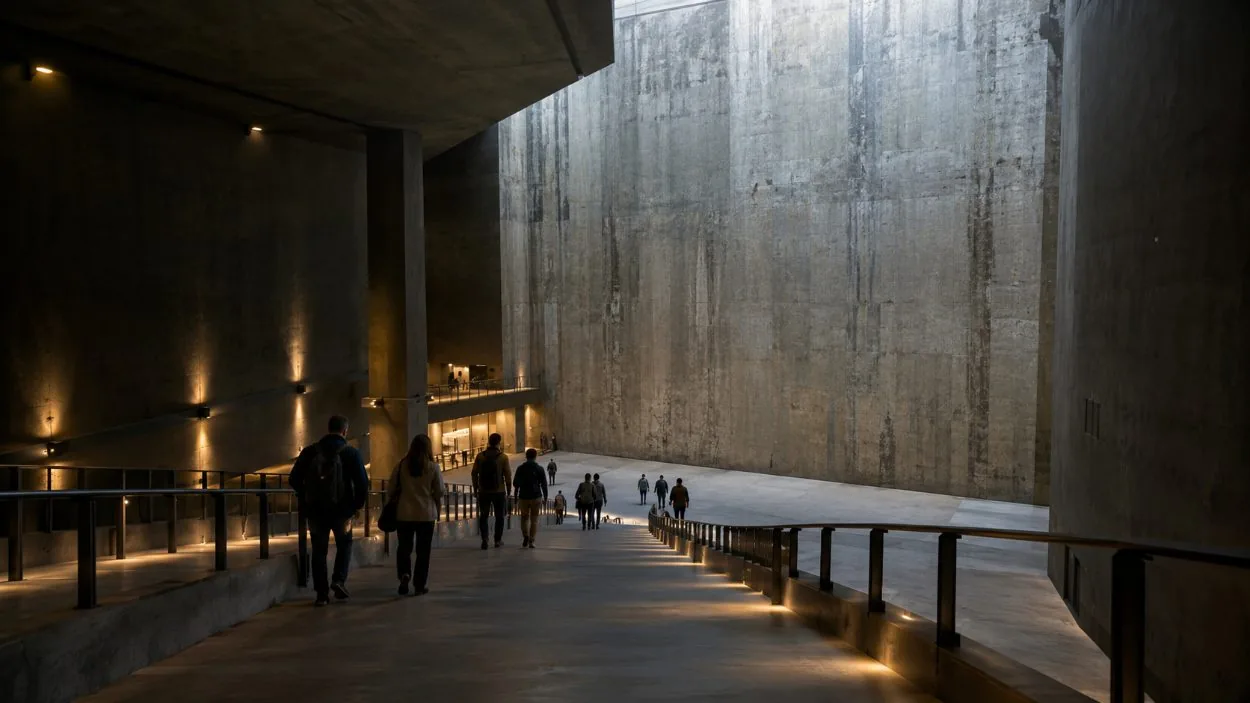
Foundation Hall is the largest space, against the exposed slurry wall that held back the Hudson River during the original construction and after the collapse. In it stands the Last Column, the final piece of steel removed from the site, on 30 May 2002, which ended the recovery. Benches are placed here and in Memorial Hall.
The Historical Exhibition
The Historical Exhibition covers the day itself, what came before it and what followed. It is where most of the artefacts and personal accounts are shown. No photography is allowed inside it. The museum does not recommend it for children under 10; the children page passes on that guidance.
In Memoriam
The Memorial Exhibition, In Memoriam, shows portraits and personal belongings of the 2,983 people killed in 2001 and 1993. No photography is allowed here either, and the same under-10 guidance applies. Christopher (UK) mentioned the personal memorabilia as the part of his guided tour that stayed with him.
The objects on the way
- The Survivors’ Stairs, the Vesey Street staircase used by hundreds to escape.
- The FDNY Ladder Company 3 truck.
- A segment of the North Tower antenna.
- Spencer Finch’s wall of 2,983 blue watercolour squares, “Trying To Remember the Color of the Sky on That September Morning”, set around a quotation from Virgil.
The collection holds more than 10,000 artefacts in all. Darran (UK) wrote that the many artefacts gave a better understanding, and Ralf (Germany) that “the museum is very tough”.
The photography rule
Personal photography is allowed in the museum for private use, without flash, except in the Historical Exhibition, In Memoriam, the auditorium and the security areas, where none is allowed. The full list of rules is on the visitor rules page.
The museum is kept at 68 to 72°F. Two hours at bedrock is long enough for a light layer to matter, even in July.
Frequently asked questions
What is inside the 9/11 Museum?
Three exhibitions, the slurry wall, the Last Column, the tridents, the Survivors’ Stairs, the Ladder 3 truck and more than 10,000 artefacts. The museum ticket page covers entry.
Is the slurry wall in the museum?
Yes, exposed along Foundation Hall, with the Last Column standing in front of it.
Can you take photos in the 9/11 Museum?
Without flash, for private use, except in the Historical Exhibition, In Memoriam, the auditorium and the security areas. See the rules.
Are there unidentified remains in the museum?
A repository exists behind a wall at bedrock; it is not an exhibit and is not visible to the public. The repository page states this once, plainly.